Darkroom NotesSeason 3STIL.BIZPart 1 of 6
The cards I didn't want to upload — Darkroom Notes, Season 3, and a fourth app: STIL.BIZ
The contents of a business card holder, when you think about it, aren't really yours. The names, companies, phone numbers, emails — they're other people's personal data. Uploading all that to a server just because it's convenient never sat right with me. Darkroom Notes, Season 3: my fourth app, STIL.BIZ, starting with why I made it.
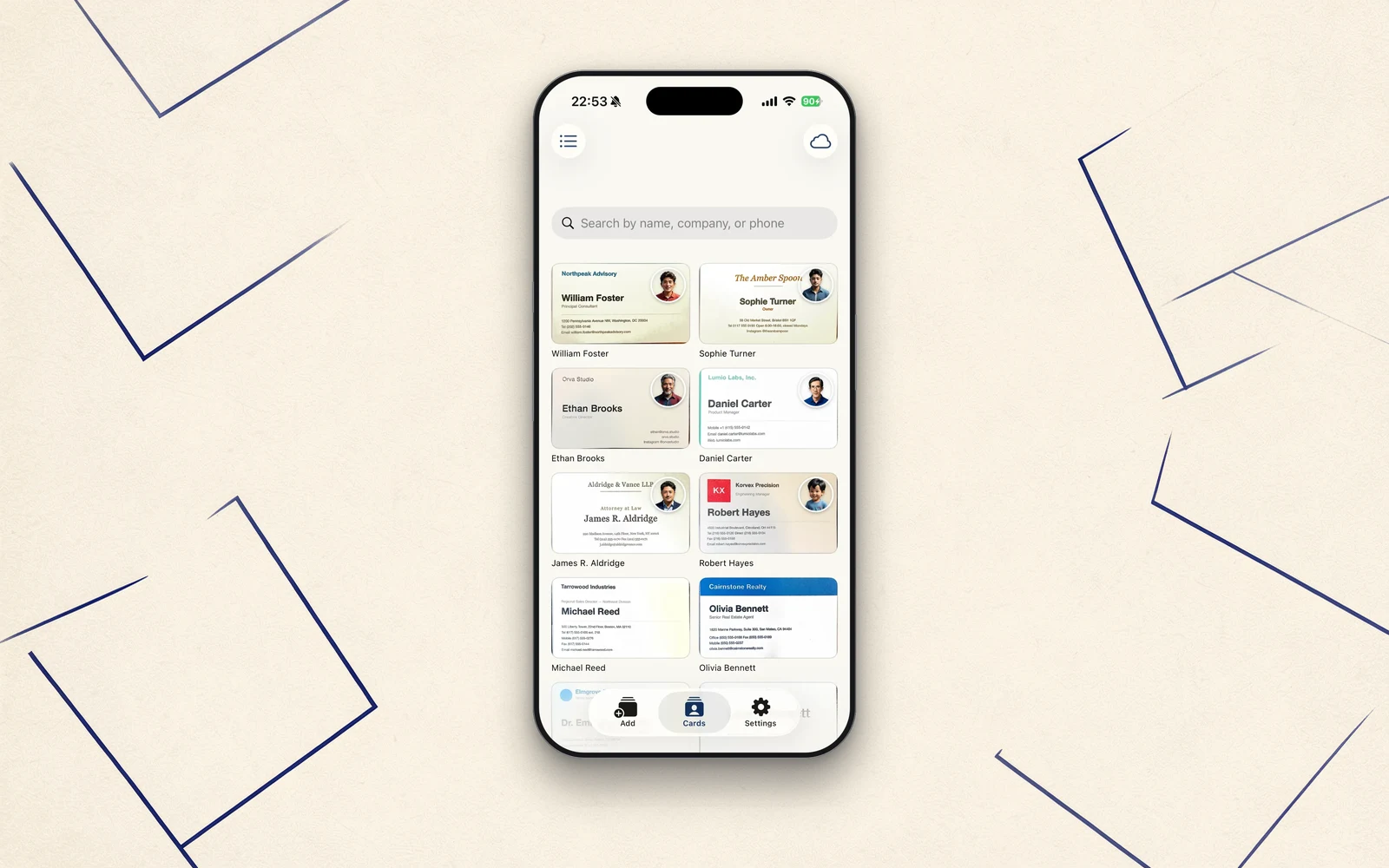
In Darkroom Notes, I've written about building STIL., which pulls one frame out of a video, and STIL.TOON, which turns faces into illustrations. Season 3, starting today, is about a fourth app: STIL.BIZ. Scan a business card with the camera, and it becomes a contact. A card, into a contact. For the first time, I've built a tool not for daily life but for work. As always, the first frame is the simplest question — why I made it.
A card is a bundle of someone else's data
Open a business card holder and it's clear: almost none of what's in there is your own information. It's other people's names, companies, departments, phone numbers, emails. Sometimes it even holds the relationship itself — who you're connected to, and at which company.
There are plenty of convenient services that photograph cards and manage them in the cloud. I understand the convenience. But it never sat right with me. My own photos are one thing — but is it really fine to upload contacts I've been entrusted with to someone else's server? A card is something a person handed to you; being placed in some cloud probably isn't what they had in mind.
So, only inside the device
STIL.BIZ scans a card, reads it, sorts the fields, and turns it into a contact — all of it, start to finish, inside this iPhone. Capture, text recognition, sorting, storage — none of it leaves the device. Nothing is sent to a server, and there's no account to create.
With STIL., the one thing I least wanted to bend on was "your material never leaves the device." With BIZ, that weighs a little more. What's being protected isn't my own material, but someone else's information, entrusted to you. That's exactly why I refused to budge on the one point: it doesn't leave the device.
The fourth is a tool for work
STIL. (one frame from a video) and STIL.TOON (faces into illustrations) were, if anything, tools for daily life. BIZ is the family's first tool for the work side.
A business card is where a working relationship begins. Which is exactly why it holds information you can't treat lightly. Rather than handing it over in exchange for convenience, you deal with it entirely in your own hands. A tool for work, I think, should be that way.
What I'll write in Season 3
In this Season 3, I'll pull out, one at a time, the things that happened while building STIL.BIZ.
- Why I didn't build a custom camera, even for a card-scanning app
- How I got the same experience to devices where the AI doesn't run
- Freezing on the fifth card in a row, and rebuilding the whole approach
- Why I stopped dropping cards with "the focus seems soft"
- How a captured card becomes a contact
As with the first two apps, I'll write from backstage, with no exaggeration. It's the story of the family growing by one, over on the work side.
Beginning
A card, into a contact. Without putting information I've been entrusted with onto anyone's server. That's what I made STIL.BIZ for. Next time, I'll start with why I didn't build a custom camera, even for a card app.
STIL.BIZ is out on the App Store. You'll find more about the app at stil.photo/biz, and the app itself on the App Store.