Darkroom NotesSeason 4STIL.RECEIPTPart 5 of 6
The word I won't write — wording around tax
"Fully compliant with the invoice system." "Fully compliant with the recordkeeping law." Written in one line, it would probably be strong. Clear, eye-catching. But I didn't write it. Tax is law, and I'm someone who builds apps, not a tax accountant. Holding back the convenient one-liner — a story about wording.
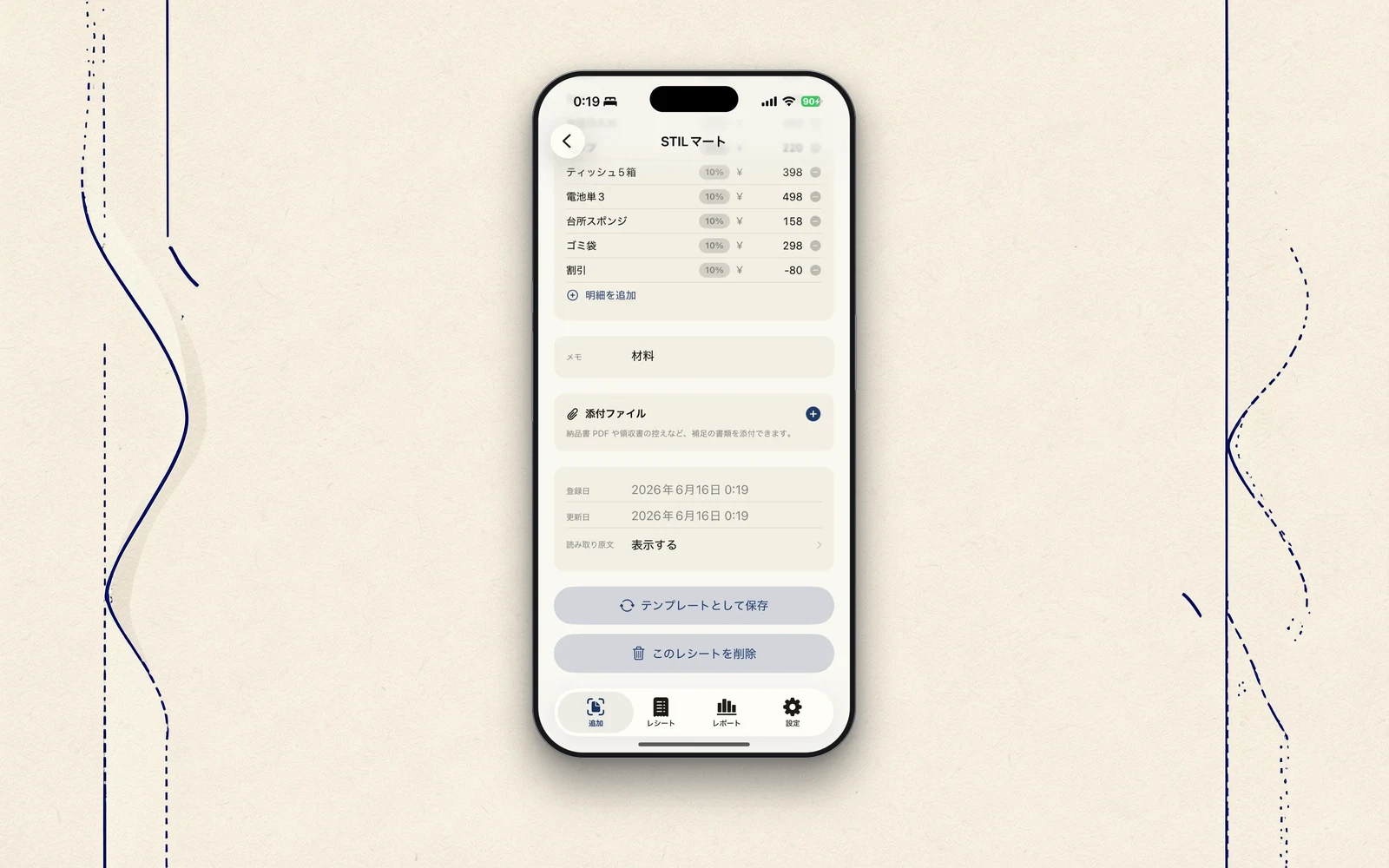
So far I've written about the technology of reading receipts. The last two posts are a little different in tone. Today, copy — words. Not the app itself, but how I describe it — there's one decision I made there.
The pull to write "fully compliant"
A receipt app inevitably touches the invoice system and Japan's Electronic Books Preservation Act — the recordkeeping law. It reads registration numbers. It saves records to match the search requirements. So as marketing copy, being able to write "fully compliant with the invoice system" or "fully compliant with the recordkeeping law" — one line, done — would probably be strong. Short, clear, eye-catching. Easy to surface in search, too.
I understand the pull completely. There are apps out there that do write it that way.
But I'm not a tax accountant
Still, I didn't write it.
Tax is law. And I'm someone who builds apps — not a tax accountant, not the tax office. The moment you declare "fully compliant," the words ring like a legal guarantee. They can be taken as "use this, and your tax filing is fine."
What if someone who trusted that one line had their filing turned back somewhere. What if the system itself changed, and "fully" stopped being fully. The convenience of one line could become real harm to someone. That wasn't a promise I could carry.
So I write what it actually does
Instead, I decided to write down what the app actually does — the actions themselves.
Not "compliant," but "automatic reading and format-checking of the invoice registration number." What it can do. Not "compliant with the recordkeeping law," but "storage searchable by transaction date, amount, and counterparty (the fields matching that law's search requirements)." Which requirements it follows. Don't let one convenient phrase blur the line between what it can do and what it can't yet.
It gets a little longer. A little less crisp. But one accident becomes much less likely: a reader carrying a misunderstanding into a procedure that matters.
Not exaggerating was the brand
This was the hardest test of "don't exaggerate," the rule the STIL family has kept all along.
Not writing "the strongest" or "dramatic" is the easy part — anyone can see those are overblown. But where "fully compliant" would do in one line, deliberately spending two to write it precisely, without blurring anything — that's where the character shows, I think. Hold back the convenient phrase. Don't underestimate the reader.
The harder a word sells, the more easily it becomes a lie to yourself. Decide to write only facts, and what you can write shrinks a little. But the lies can be zero. In a domain like tax, where mistakes aren't allowed, that awkwardness was what I wanted to choose.
Next time
Next is the finale. I'll trace how a single captured receipt becomes an expense, start to finish, write what I came to think after building a fourth tool — and close Season 4 of Darkroom Notes.
STIL.RECEIPT is out on the App Store.