Darkroom NotesSeason 5STIL.NOTEPart 3 of 6
The meeting that never happened — teaching the summary not to invent
A recording of nothing but the word "Yes." came back with a full meeting summary attached — decisions, to-dos, the lot. Summarize a 14-minute conversation and you'd get "28 decisions." The real number was zero. The AI was saying more than it had heard, again. What I fixed wasn't the model. It was how I was asking.
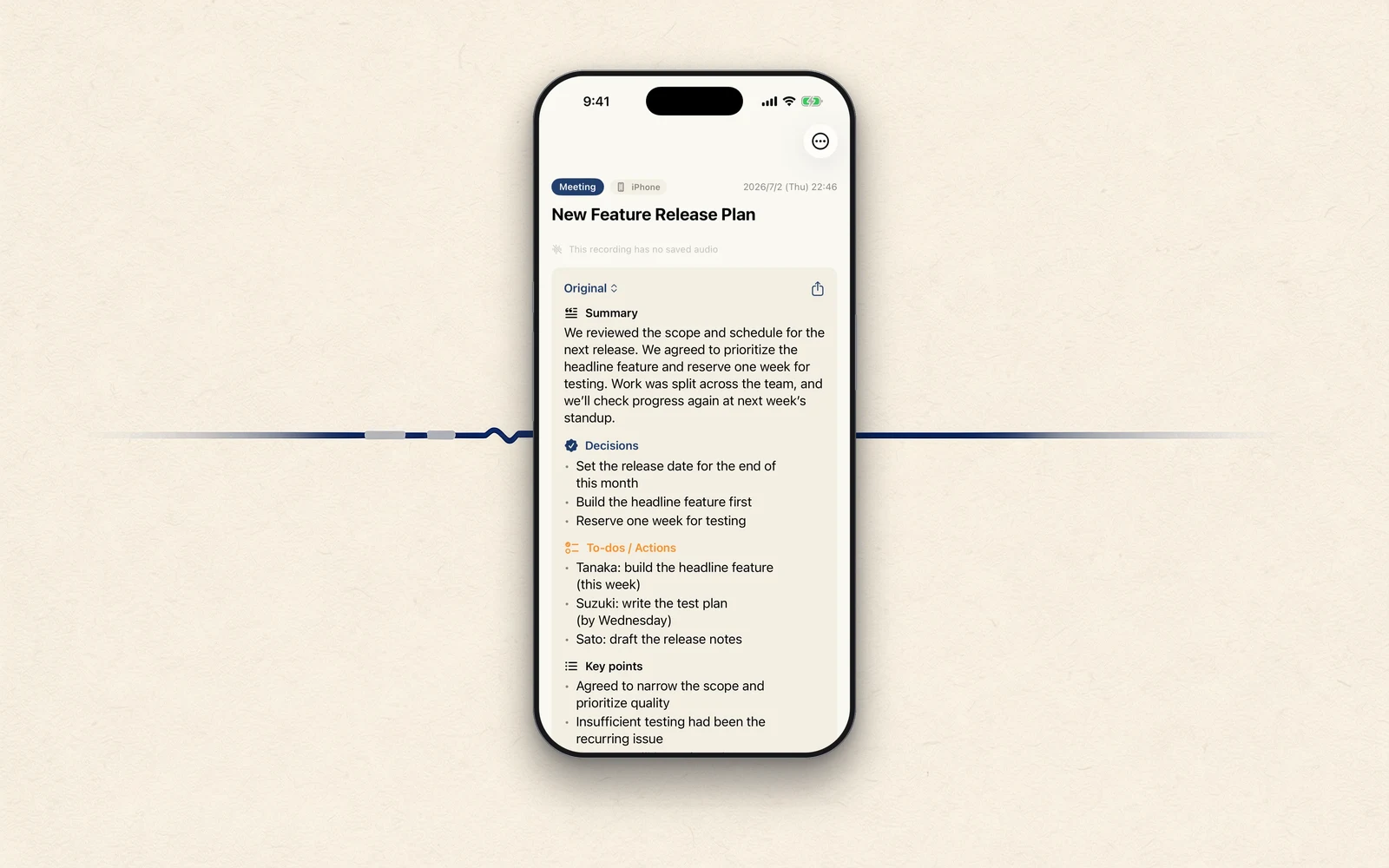
Last time, a machine pretending to know who spoke. Today, a machine inventing what was decided.
A meeting grew out of "Yes."
During testing, I had a recording where I said "Yes." and hit stop. A few seconds long, with nothing in it.
The summary attached to it made me look twice. A row of decisions. A row of to-dos. A plausible little meeting summary, grown out of thin air. Nobody had held any meeting.
When an AI runs short of material, it sometimes fills the gap with something plausible. With receipts, it invented numbers that weren't there. This time it was doing the same thing with words.
Twenty-eight decisions. The real number: zero
Was it only a short-recording problem? No. I had it summarize a 14-minute conversation — two people discussing a book, deciding nothing — and it came back with "28 decisions" and "28 to-dos."
The correct answer is zero for both. Non-decisions filed under decisions, errands nobody asked for filed under to-dos. The summary had become padded minutes for a meeting that never happened.
The fault wasn't the model — it was the asking
A long recording can't be handed to the AI whole, so I was splitting it into fragments of about 1,000 characters. And for each fragment, I asked: "Sort this into decisions, to-dos, and key points."
That was the mistake. Even when a fragment contains no decision, an AI handed a box labeled "decisions" tries to fill the box. Hand it ten fragments and you get ten rounds of invented decisions. The classifying was what caused the confabulating.
Ask only for facts
The fix was to restructure the asking.
Each fragment now gets one request only: "Write 3–5 lines of factual notes on what was said here." No classifying. Whether something is a decision gets judged only after all the fragments' notes are in, looking at the whole. And even then, not as the big question — "sort this into decisions, to-dos, key points" — but broken all the way down to a yes-or-no: "Is this a decision?" A model too weak for the big question can answer a yes-or-no properly.
Zero decisions
On the same 14-minute conversation, the rebuilt summary returned zero decisions, zero to-dos, six key points. For comparison I had a large cloud model summarize the same recording. Same answer: zero decisions. A small model in the palm of your hand, asked the right way, landed on the same result.
Most of what had looked like the model's limits was the shape of the task.
One more thing
Recordings under 40 characters don't invoke the AI at all now. "Yes." stays "Yes." — because that is the most accurate summary of it.
Next time
After teaching it not to invent: learning not to lose. The story of how I lost fifteen minutes of audio outright, and rethought the order that saving comes in.
STIL.NOTE is out on the App Store.