From the ShelfPart 5 of 11
Eric Clapton — Unplugged: an album that connects the boy I was to the father I am
An album that found me in middle school, through my older brother's love of Clapton. The song I copied night after night was “Tears in Heaven,” and the story behind it I only really understood once I became a father myself. Thirty years on for the album, thirty years on for us.

Eric Clapton's Unplugged (1992). The MTV Unplugged live recording — the album that proved to the world that a rock guitarist could ring out like this on an acoustic guitar.
For the fourth entry in the From the Shelf series, I picked this one without hesitation.
The middle schooler I was, and the father I am now. This album knows both of them.
How I met it — through my brother's Martin 000-28
I came across this album when I was just starting middle school.
I had an older brother, already deeper in music than I was, and he loved Clapton. To the point of owning a Martin 000-28 acoustic guitar. Growing up in that house, I'd watch his back as he sat with that one guitar, day after day.
What came out of the speakers in the living room, what came out from his hands, what made it down the hallway into my room — Unplugged got into me without my having to choose it.
The music we register as good when we're young keeps coming back, no matter how many other things we listen to later.
Tears in Heaven, and a story I once heard
You can't really talk about this album without talking about "Tears in Heaven." The musical beauty of it goes without saying. But I only learned the backstory as an adult.
In 1991, Clapton lost his four-year-old son, Conor, in a tragic accident. The friend who held him through that grief was George Harrison.
Around that period, Clapton came to Japan, and he met a sakuramori — a "cherry-tree keeper" — at a Japanese garden somewhere. The work of sakuramori is to look after and pass cherry trees down across generations, quietly and without fanfare. That meeting, I once read, became one of the inspirations for the song.
I can't verify all of those details. They live in the realm of "something I read, somewhere." But when you listen to that song, you can feel both a sense of cycles, of life flowing onward, and a will to keep living forward in spite of the loss.
A father giving voice to a song aimed at his lost child — and yet, the song doesn't sit on the side of despair. It stands on the side of time continuing.
When I listen to that song again now, as the father of a four-year-old myself, it lands nothing like it did when I was in middle school.
The video above is Clapton playing it again, more than thirty years later. A man who carried this song through thirty years of life, and the rest of us, who listened to it through those same thirty years. There's a kind of corridor between us, threading through that long stretch of time.
A path every guitar kid walks
If you played guitar, "Tears in Heaven" is a song you pass through at some point — one you can't help wanting to play. I was one of those kids. I copied it night after night.
I remember performing it in middle-school music class. The problem: the only guitars in that room were classical guitars — nylon strings, a wide neck, awkward with a pick. Not an instrument built for Unplugged. Playing it on one of those was a real struggle.
And one small heroic moment from that era: being able to tune a guitar without a tuner was, by itself, enough to earn a kind of status. You'd remember the A pitch, tune the fifth string off it, and the rest by ear. Not perfect. But "I tune mine by ear" was enough to hold down my seat as the music kid of the class.
Fond memories, all of it.
The track I most enjoy playing — Signe
I've spent most of this post on "Tears in Heaven," but the song I personally love to play most is the album's opener, "Signe."
A bossa-nova-inflected acoustic instrumental, with Clapton's blues-side phrasing folded inside it. A track that opens the album with a real lightness — the reason Unplugged isn't only a heavy-memory record. Your shoulders drop, and the song drifts by like a late-afternoon breeze.
Layla, also thirty years later
The other unforgettable moment on this album is the acoustic version of "Layla." That roaring rock classic, slowed down and replayed on a 1939 Martin 000-42 — a performance that redefined what rock could be. The same Martin 000 size as my brother's 000-28.
This one, too, has a thirty-years-later performance.
There is something very good about watching a man play the same song with thirty more years in his fingers.
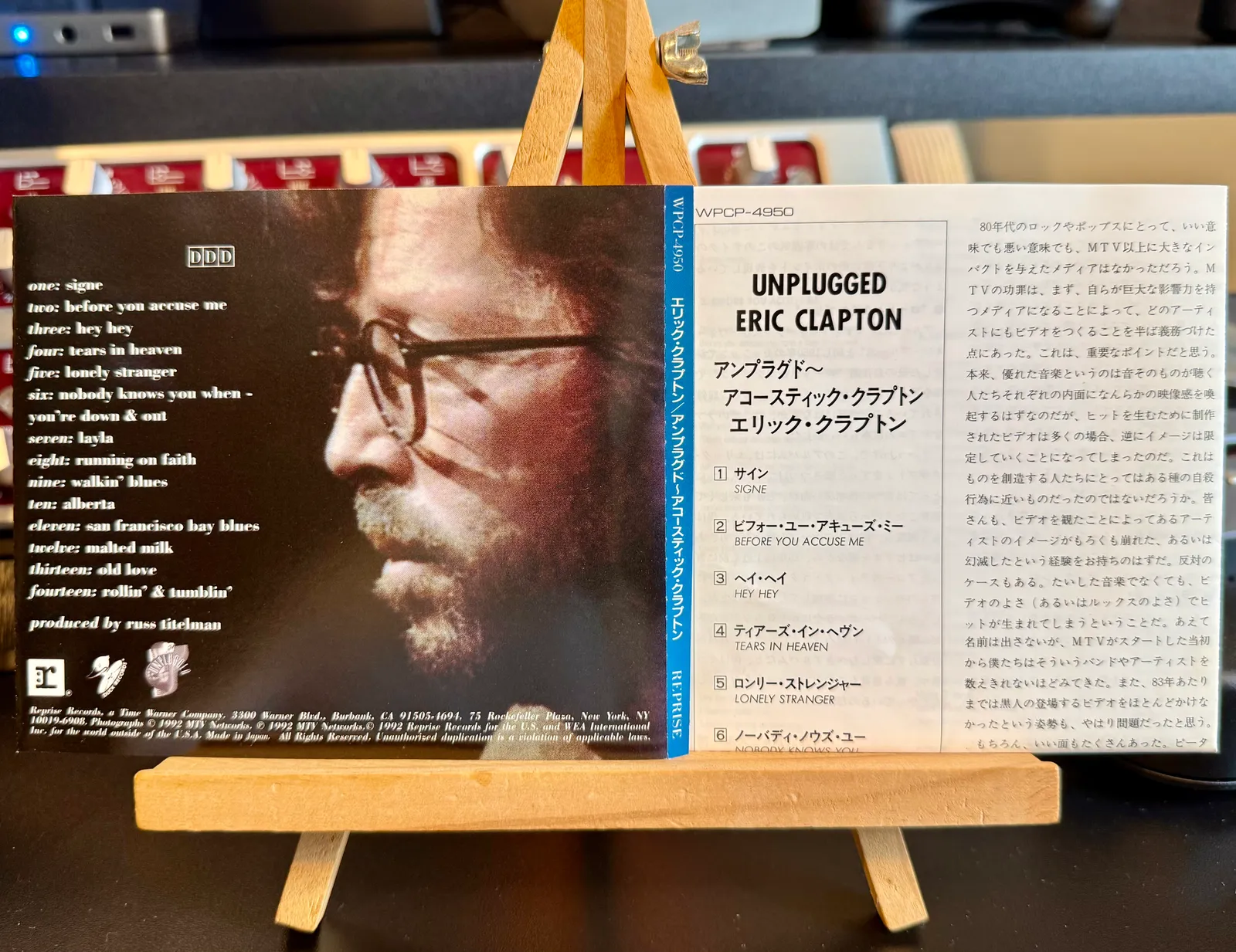
Listening with a father's heart
To close, back to "Tears in Heaven."
When I listen to this album now, something in my chest tightens the way it only does for a parent. Which makes sense, because I am one.
Songs that lodged themselves into a middle-school version of me don't politely stay there. Each time I play them back, they shift slightly to match my temperature today, and I hear them differently.
The sound that came out of my brother's Martin, the clumsy nylon-string version I made in a music classroom, and the version playing softly in my living room now, with my own kid nearby — somehow they all live inside this one disc.
Pick another one off the shelf
That's entry number four of the From the Shelf series.
The way one album can move you back and forth between a younger you and a present you — that's an experience you might only get when you still keep CDs as objects, and still bother to pull them off a shelf.
Next disc — undecided. I'll open the closet, see what catches my eye, and bring another one out.
Listen