From the ShelfPart 7 of 11
Richard Ashcroft — Alone with Everybody: on a voice that makes you cry without understanding the words
The Verve's frontman, on his own. My definition of a charismatic vocalist has always pointed to Richard Ashcroft before Liam Gallagher. Track five — You on My Mind in My Sleep — brings tears every single time, and I still can't fully explain why.

The debut solo album from Richard Ashcroft, frontman of The Verve. Alone with Everybody (2000).
Entry six of the From the Shelf series.
A charismatic vocalist — and for me, it was always him before Liam
When someone says "charismatic rock vocalist," who comes to mind first?
For a lot of people, it's probably Liam Gallagher of Oasis. I like Liam too. But when I reach for the word "charismatic," the name that arrives first is Richard Ashcroft.
What I mean by charismatic here is the quality of his voice and his instinct for melody. Not stage presence, not how he carries himself in interviews.
There's a strange weight to Ashcroft's voice. Even when I can't follow every word, there are moments while listening when the tears just come, almost on their own. What kind of life do you have to live to end up with a voice that thick? I've asked myself that every time I've put this record on.
Finding The Verve in music college
I first came across The Verve during my time at music college.
As I wrote in the opening entry of this series, I moved to Tokyo at eighteen to study music, and my friends and I fell headlong into collecting CDs. Carrying home stacks of imports from HMV. Racing to rip rentals from the Shibuya TSUTAYA into iTunes before the deadline. The Verve was one of the bands that found its way onto the shelf during those years.
The Verve is one of those names you can't leave out of any account of 1990s UK rock. Their 1997 album Urban Hymns went global, and "Bitter Sweet Symphony" still turns up in films and advertisements.
But this was also a band that fought constantly and broke up three times. When strong personalities collide, that kind of friction is probably unavoidable. The same was true of Ian Brown and John Squire in the Stone Roses, and of the Gallagher brothers. Charisma and the difficulty of working alongside someone else — I suspect they tend to arrive as a pair.
And it was the frontman of that band who, in 2000, stepped out under his own name with Alone with Everybody.
On going solo, briefly
In entry two of this series, writing about John Squire's debut solo album Time Changes Everything, I described him as someone who lets someone else be the front, and channels his own talent through that person.
Richard Ashcroft is the opposite.
He was always the frontman — the one standing in the middle of the band, carrying his own melodies in his own voice. So his solo work doesn't have the freshness Squire's had, that sense of so this is what he sounds like when he finally steps forward.
What happens when someone who was already the front sets the band aside and makes a record alone? This album is that experiment.
Pulling back from The Verve's dense, layered sound, Ashcroft builds Alone with Everybody around strings and acoustic guitar, with the vocals at the centre. Without the band at his back, the outline of the voice comes closer. There's nowhere for it to hide, and it doesn't try to.
Writing about music as a job, for a time
The story jumps ahead a little. After I graduated and started working, there was a stretch where I wrote music reviews as a job.
One of the albums I was assigned was Ashcroft's third solo record, Keys to the World (2006). Writing about an album means listening to it over and over — reading the liner notes, going back through earlier releases, sitting with it long enough to find something true to say. I did all of that with this one.
Writing about something you love makes you love it more. Heard again through that process, with a few more years of my own behind me, his voice landed differently than it had when I was a student. Some of that was probably down to me having changed.
The reason I write this blog probably comes from the same root. Going back over what you loved, finding words for it again. There are places you can only arrive at by doing that more than once.
Track five: You on My Mind in My Sleep
My favourite track on this album is "You on My Mind in My Sleep" — the fifth song.
Not a single. Nothing dramatic in the arrangement. The kind of song that asks you to close your eyes and just listen — quiet, unhurried, gentle.
Ashcroft's voice shows its truest quality in moments like this. Not pushed, not performing. Just carrying the melody, placing it down, letting it be.
This is always the track that brings the tears. Even without catching every word, something comes through. The voice carries something that arrives before the language does — that's the closest I can get to describing it.
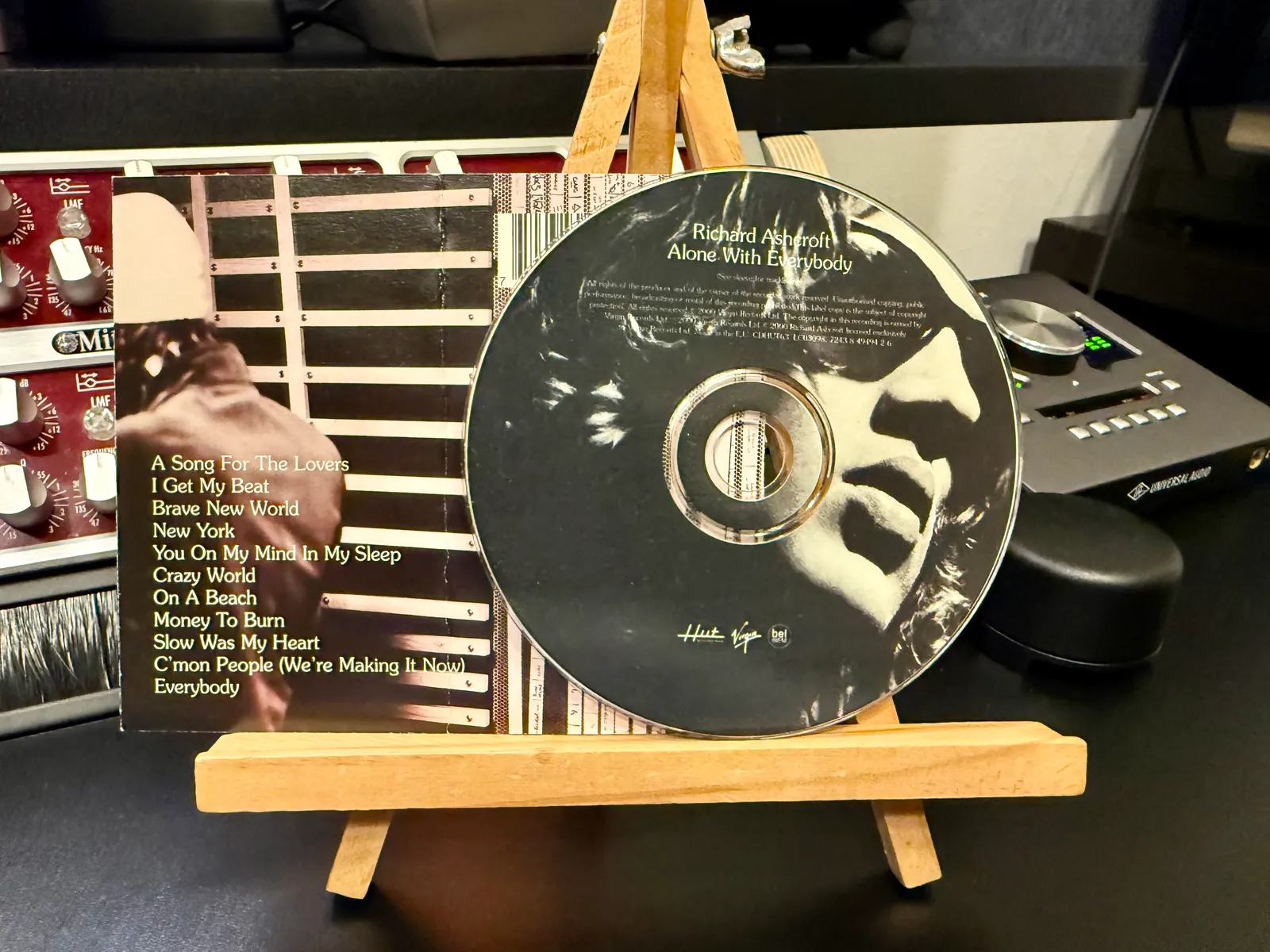
A shelf of UK rock from the same era
Travis, Stereophonics, Coldplay, and The Verve — the bands this series has taken off the shelf so far — were all making music in roughly the same stretch of UK landscape.
Stadium-scale ambition, inward-looking lyrics, a certain damp British quality in the sound. Each of them stood in a different place, but line them up on the shelf and they connect somewhere, strangely.
The Verve might have been the most precarious of the lot — disbanding and regrouping and disbanding again. The fact that Ashcroft's solo work exists at all is inseparable from that instability. An album made alone, called Alone with Everybody. It feels like the title already knows what it's about.
Pick another one off the shelf
That's entry six of the From the Shelf series.
I still don't know what Richard Ashcroft went through to end up with that voice. I probably never will. But every time I take this CD off the shelf and put it on, the tears come in exactly the same place. That much hasn't changed.
Next disc — undecided. I'll open the closet, see what catches my eye, and bring another one out.
Listen